

Review: Night is More Abstract by Miklavž Komelj
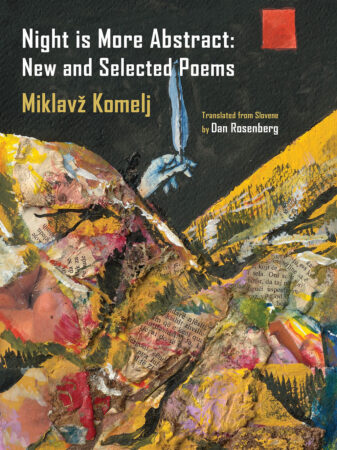
| Translated by | Dan Rosenberg |
| Genre | Poetry |
| Language(s) | Slovenian, English |
| Format | 208 Pages |
| Publisher | Zephyr Press |
| ISBN | 9781938890383 |
Reviewed by Amanda L. Andrei
Mouse bones, owl pellets, and small silver pails appear amidst the dregs of communism, karma, and resurrections as Komelj’s poems play with size and scale from the minute to the epic. This fresh translation, Night is More Abstract: New and Selected Poems, imparts the abstractness of night not only on a mundane level, but also on a cosmic one (Zephyr Press, 2025).
Born in 1973, Komelj is a Slovenian art historian, writer, and poet with seventeen books of poetry; this new translation by poet Dan Rosenberg brings in selections from seven of those volumes as well as brand new poems.
In “The Red Flag,” a lyrical whirlwind highlighting the crimson color, the poet is in conversation with filmmaker Pasolini’s Italian poem “Alla Bandiera Rossa” (“To the Red Flag”). Both poems scrutinize the red flag’s connotations with communism, class, and poverty. Komelj takes it further: “to get back to cherries, to get back to blood.” These earthy images are contrasted against Hitler, Christ, the narrator’s memories of a socialist society, and a confident sense of the mysteries of heaven and earth:
Did the gods, when they saw
the blood, find in their mouths
the taste of cherries?
(I know that feeling.)
It’s not just objects and ideologies that make their appearances. Along with dictators and religious figures, an international cadre of philosophers and artists march across the poems along with anonymous and transient folks—saints, sinners, and laypeople mingled alike. From an old man near a parking lot to the early theologian St. Augustine, from a tattooed woman on a bus to the Egyptian god Horus, Komelj conjures multiple historical and contemporary characters into his work, treating icons and strangers with equal reverence and ferocity.
Take “The Lullaby of Isis,” originally from the 2021 collection The Burning Book, in which a narrator—the Egyptian goddess Isis of magic and motherhood—considers the “down of baby hair” as it becomes a quill while she touches the head of her child Horus, the god of Sun and Sky. The tone is maternal, royal, domineering, and religious, then shifts along with its stanza structures, transforming into a series of smaller poems under the guise of the lullaby. It breaks into more fragments, the quotidian rubbing up against terror:
In the middle of the road—
a bird—
no—a black plasticbag—
no—
a slipper.How
they scream in the next
room!
The poem pulls in Latin and Italian; verses repeat as if chanted by a chorus. The words could be Isis still singing, or they could be the Sun God himself, finding his way across terra firma and repeating:
This is not a forest at night—
this is a night forest.
What you find within your might
is your greatest mystery.
Rosenberg provides a heartfelt translator’s note that emphasizes his conundrums, guiding questions, and principles as he encountered the Slovenian and multilingual poems. Pointing out conflicting translator goals and priorities, especially when teasing out assumptions of what Slovenian readers would know from Komelj’s personal poetic allusions and imagery, he muses, “Is my goal even to create an analogous experience, in English, to what Slovenian readers might encounter in his work? Is the stable notion of Slovenian readers even coherent?”
The question is as philosophical as Komelj’s verses. Who receives these tides of mundane and cosmic images, and what do they do with them?
As systems, cultures, and attitudes shift in disproportionate and unpredictable ways across the world, these questions are worthwhile for any translator as they consider their audiences and for whom they translate. Ultimately, Rosenberg’s translations reflect his desires and actions to “simply honor what is most exciting” and to create a richly textured English translation.
“I did my best not to smooth what he made rough,” he explains. In doing so, Komelj and Rosenberg present readers with a witching hour that screams, a darkness that glows.

Amanda L. Andrei is a playwright, literary translator, theater critic, and community archivist, named as one of three Rising Leaders of Color by the Theatre Communications Group (TCG) for their 2023 cohort of theater journalists. She writes epic, irreverent plays that center the concealed, wounded places of history and societies from the perspectives of diasporic Filipina women, and she co-translates from Romanian to English with her father, Codin Andrei.
She is the founder of The Palangga Archives and has presented her work on the archives at the Filipinx Studies Conference at UC Davis’ Bulosan Center for Filipino Studies. She has an MA from Georgetown University and an MFA from the University of Southern California.
SUPPORT SEEFEST
Not a member yet? Become an art patron with other SEEfest arthouse aficionados in support of great events and programs. Our mission is to keep you informed about initiatives from our wide network of fellow cultural organizations.
We Welcome YOU!
SEEfest 2026: Film Trailers
A bold cinematic journey begins here. This curated series of trailers offers a glimpse into the vibrant, provocative, and deeply human stories showcased at the South East European Film Festival (SEEfest). From gripping narratives to powerful documentaries, these films reflect the cultural richness and complexity of South East Europe, where history, identity, and innovation collide.
Each trailer is an invitation to explore new perspectives, challenge assumptions, and experience storytelling that transcends borders. Together, they capture the spirit of SEEfest, a festival dedicated to amplifying diverse voices and fostering cross-cultural dialogue through cinema.
Watch on YouTube.
SEEfest 2026 Schedule & Tickets
SUPPORT SEEFEST
Not a member yet? Become an art patron with other SEEfest arthouse aficionados in support of great events and programs. Our mission is to keep you informed about initiatives from our wide network of fellow cultural organizations.
We Welcome YOU!
Review: Breadcrumbs by Kasia Babis
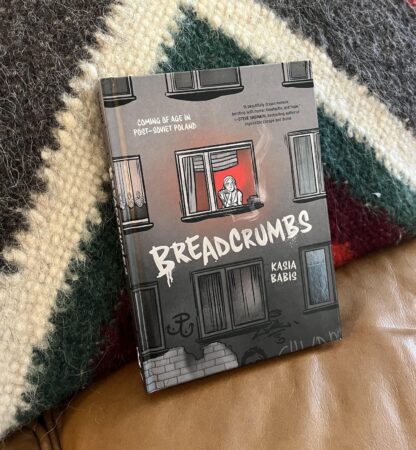
| Author | Kasia Babis |
| Genre | Graphic Memoir |
| Language(s) | English |
| Format | 256 Pages |
| Publisher | Macmillan Press |
| ISBN | 9781250877871 |
Reviewed by Lauren Halvonik
“One day you will learn respect for the fatherland, respect for bread. I will make you learn.” –Kasia Babis in Breadcrumbs
That is what the surly headmistress of Kasia’s Catholic school flings her way, in response for daring to drop breadcrumbs upon the floor. A dramatic statement following the denouement to the main character (Kaisa) reciting My Little Song III by CK Norwid. As one of the great Polish Romantic poets, Norwid is a fine choice here; his poem is about longing for the exaltation of bread and god, and of land and faith.
A New Poland
This (opening) scene sets the tone of this graphic memoir by Kasia Babis. The headmistress retreats with all the flair of a drama teacher, leaving Kasia in shock, accented by humored confusion. As Kasia and her classmates laugh over the headmistress’ eccentricities, their relationship deepens amidst the backdrop of Poland transitioning from communism to capitalism. Ultimately this is a graphic memoir about autonomy, extending from one’s body to one’s home–an extension of the self.
In this new Poland, Catholicism now sits at the forefront–not as background noise that some choose to worship, but as a cemented presence in school and state. This rising tide of conservatism, a reaction to the socialist society that had just crumbled–begins to endanger the autonomy of our young heroines. Readers may notice it foreshadowed in the make-up being scrubbed off young girls, or in the strict uniforms the girls have to wear.
Breadcrumbs conveys how in times of uncertainty and strife, people often turn to doctrine and absolutes.
Throughout the graphic memoir, mothers cling to religion like the last buoy flung off a sinking ship. Babis highlights how mothers can inflict trauma on their daughters, often out of fear. For Monika’s mother, like for many women in Poland, life is not simple. Catholic faith becomes her anchor. In one disturbing scene, Babis illustrates how daughters are reminded that abortion is a sin. Monika opens the fridge, looking for leftover dinner, and instead finds a Tupperware with a cross drawn on it and the words “Lenka 02.2010-04.2010.” In a panic, she calls Kasia to share news of the miscarried fetus in the fridge. Babis then jumps forward–the next readers learn of Monika, she’s being committed to a psychiatric institution by her mother.
Beyond the intricacies of motherhood and childhood, Monika’s story introduces the burgeoning sentiment against abortion in post-soviet Poland. Breadcrumbs is also a tale about the loss of personal autonomy and the fight to protect it. Even in Monika’s mothers actions there is a sense that she feels a loss of autonomy in this new Poland. She’s struggling financially and has no external help available to her for the care of her five children. She has to lean on Monika for help and even reminds her of that as they’re at the steps of the psychiatric institution. Her faith in Jesus and the Catholic Church makes her feel some sense of control, of autonomy.
While much of the book covers a woman’s right to bodily autonomy, it also examines personal autonomy through the lens of property.

Wild Reprivatization
“But how do you decide who owns what in a city that was once completely destroyed?” –Kasia Babis in Breadcrumbs
Babis presents the above question at the beginning of the story of Jolanta Brzeska. Brzeska was a tenants’ rights activist who many believe was murdered for her activism. Throughout the memoir, Babis uses actual quotes from witness reports, giving this section of the book a particularly eerie truth. For example, a young man reported that he saw something burning in the distance that night, precisely where Brzeska’s body was found.
In Breadcrumbs, he ask an unanswered question:
“If she just lay there, burning alive…why wasn’t she screaming?”
Strajk Kobięt
“Men’s anger. Why does it always take me by surprise?” –Kasia Babis in Breadcrumbs
In Babis’ final act, she returns to an intimate interlude that is once again, a meditation on mother’s and daughter’s, on women’s perseverance and on men’s anger. This part takes place amongst the political backdrop of Partia Razem, a left leaning party in Poland whose name signifies “togetherness” and Strajk Kobiet, the All-Poland Women’s Strike. For context, the strike unfolded in 2016 and again in 2020, largely in response to increasingly restrictive anti-abortion laws. Babis documents how,
“The battle over abortion we fought in 2016 did not put an end to the government’s war against women’s rights. In 2020, the New Constitutional Court, now packed with Law and Justice Party members, declared previous abortion laws unconstitutional. According to the new ruling, it was only legal to terminate a pregnancy if it was threatening a woman’s life or if the pregnancy was a result of rape. In response to the ruling hundreds of thousands of people went to the streets in the biggest protest since the fall of communism.”
Finally, in 2016, the protagonists feel the power of their voices. Especially Kasia, who leads a portion of the march, and speaks to the crowd with Partia Razem.
The memoir ends with the girls finding each other once again, now with Monika’s daughter, Matylda. In the light of motherhood, they reflect on their mothers and empathize with the difficulties they had. Monika contextualizes how even though her mother hurt her, her mother was also responding to her autonomy being stripped from her.
There is so much in Breadcrumbs to discuss and share. Babis takes readers on a journey through Polish history with such a beautiful and detailed pen. This memoir covers the facets of womanhood and disenfranchisement in a way that reminds readers that we all deserve autonomy. And that often, we have to fight for it.
“Sometimes I think there’s no way anyone from that generation didn’t come out at least a little bit fucked up, you know?” “Well to be fair I don’t think we’re that well-adjusted either.” “That’s how it works, right? Generational trauma or something. At least we acknowledge it. Let’s hope someday someone breaks the cycle.”
Additional Reading
- Babis, Kasia. Breadcrumbs: Coming of Age in Post-Soviet Poland. Macmillan, 2025.
- Norwood, CK. “My Little Song III” a translation of the CK Norwood poem included in Breadcrumbs.
- Tilles, Daniel. “Prosecutors Discontinue Investigation into Warsaw Tenants’ Rights Activist Who Burned to Death.” Notes From Poland.

Lauren Halvonik is a freelance writer and photographer based in Los Angeles, California. She focuses on stories from Eastern Europe, particularly those based in the Carpathian region where her family resides. She gravitates to autobiographical stories exploring identity, displacement, and the blurred borders of our cultures, language, and land.
SUPPORT SEEFEST
Not a member yet? Become an art patron with other SEEfest arthouse aficionados in support of great events and programs. Our mission is to keep you informed about initiatives from our wide network of fellow cultural organizations.
We Welcome YOU!