

Review: Night is More Abstract by Miklavž Komelj
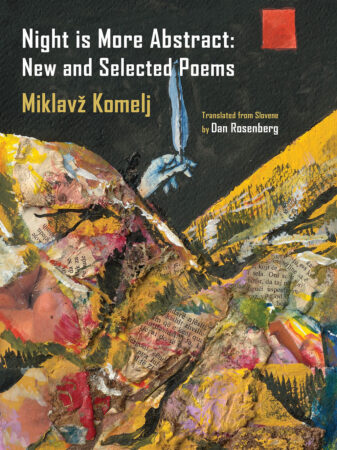
| Translated by | Dan Rosenberg |
| Genre | Poetry |
| Language(s) | Slovenian, English |
| Format | 208 Pages |
| Publisher | Zephyr Press |
| ISBN | 9781938890383 |
Reviewed by Amanda L. Andrei
Mouse bones, owl pellets, and small silver pails appear amidst the dregs of communism, karma, and resurrections as Komelj’s poems play with size and scale from the minute to the epic. This fresh translation, Night is More Abstract: New and Selected Poems, imparts the abstractness of night not only on a mundane level, but also on a cosmic one (Zephyr Press, 2025).
Born in 1973, Komelj is a Slovenian art historian, writer, and poet with seventeen books of poetry; this new translation by poet Dan Rosenberg brings in selections from seven of those volumes as well as brand new poems.
In “The Red Flag,” a lyrical whirlwind highlighting the crimson color, the poet is in conversation with filmmaker Pasolini’s Italian poem “Alla Bandiera Rossa” (“To the Red Flag”). Both poems scrutinize the red flag’s connotations with communism, class, and poverty. Komelj takes it further: “to get back to cherries, to get back to blood.” These earthy images are contrasted against Hitler, Christ, the narrator’s memories of a socialist society, and a confident sense of the mysteries of heaven and earth:
Did the gods, when they saw
the blood, find in their mouths
the taste of cherries?
(I know that feeling.)
It’s not just objects and ideologies that make their appearances. Along with dictators and religious figures, an international cadre of philosophers and artists march across the poems along with anonymous and transient folks—saints, sinners, and laypeople mingled alike. From an old man near a parking lot to the early theologian St. Augustine, from a tattooed woman on a bus to the Egyptian god Horus, Komelj conjures multiple historical and contemporary characters into his work, treating icons and strangers with equal reverence and ferocity.
Take “The Lullaby of Isis,” originally from the 2021 collection The Burning Book, in which a narrator—the Egyptian goddess Isis of magic and motherhood—considers the “down of baby hair” as it becomes a quill while she touches the head of her child Horus, the god of Sun and Sky. The tone is maternal, royal, domineering, and religious, then shifts along with its stanza structures, transforming into a series of smaller poems under the guise of the lullaby. It breaks into more fragments, the quotidian rubbing up against terror:
In the middle of the road—
a bird—
no—a black plasticbag—
no—
a slipper.How
they scream in the next
room!
The poem pulls in Latin and Italian; verses repeat as if chanted by a chorus. The words could be Isis still singing, or they could be the Sun God himself, finding his way across terra firma and repeating:
This is not a forest at night—
this is a night forest.
What you find within your might
is your greatest mystery.
Rosenberg provides a heartfelt translator’s note that emphasizes his conundrums, guiding questions, and principles as he encountered the Slovenian and multilingual poems. Pointing out conflicting translator goals and priorities, especially when teasing out assumptions of what Slovenian readers would know from Komelj’s personal poetic allusions and imagery, he muses, “Is my goal even to create an analogous experience, in English, to what Slovenian readers might encounter in his work? Is the stable notion of Slovenian readers even coherent?”
The question is as philosophical as Komelj’s verses. Who receives these tides of mundane and cosmic images, and what do they do with them?
As systems, cultures, and attitudes shift in disproportionate and unpredictable ways across the world, these questions are worthwhile for any translator as they consider their audiences and for whom they translate. Ultimately, Rosenberg’s translations reflect his desires and actions to “simply honor what is most exciting” and to create a richly textured English translation.
“I did my best not to smooth what he made rough,” he explains. In doing so, Komelj and Rosenberg present readers with a witching hour that screams, a darkness that glows.

Amanda L. Andrei is a playwright, literary translator, theater critic, and community archivist, named as one of three Rising Leaders of Color by the Theatre Communications Group (TCG) for their 2023 cohort of theater journalists. She writes epic, irreverent plays that center the concealed, wounded places of history and societies from the perspectives of diasporic Filipina women, and she co-translates from Romanian to English with her father, Codin Andrei.
She is the founder of The Palangga Archives and has presented her work on the archives at the Filipinx Studies Conference at UC Davis’ Bulosan Center for Filipino Studies. She has an MA from Georgetown University and an MFA from the University of Southern California.
SUPPORT SEEFEST
Not a member yet? Become an art patron with other SEEfest arthouse aficionados in support of great events and programs. Our mission is to keep you informed about initiatives from our wide network of fellow cultural organizations.
We Welcome YOU!
Diary of Diana B at SEEfest 2020 Online Cinema
Watch “The Diary of Diana B.”
Austrian-born Diana Budisavljević leads the comfortable life of the Zagreb upper-middle class when in the fall of 1941 she learns that Jewish and Serbian (Christian Orthodox) women and their children are being taken to Ustasha camps where they are left to die of starvation and disease. Since the Jewish Community is only allowed to send provisions to the Jewish prisoners, the equally vulnerable Serbian women and children are left helpless.
This is the untold story of how Diana organized the largest rescue operation, a campaign that, by the end of World War II, will have saved more than 10,000 children from certain death.
Don’t miss this extraordinary historical drama currently playing in SEEfest virtual cinema.
Submissions for the 36th IDA Documentary Awards extended till July 28!
Submissions are open for the 36th Annual IDA Documentary Awards, the world’s most prestigious awards dedicated solely to the documentary genre, celebrating the best nonfiction programs and documentarians of the year!
Entry is open to any non-fiction shorts, features, series, and podcasts completed or publicly released between October 1, 2019, and December 31, 2020. Apply by July 7, 2020!
Films from SEE region in Cannes Cinéfondation selection
Congrats to three student films that made the Cannes Cinéfondation selection: Agapé by Márk Beleznai, Budapest Metropolitan University, Hungary; Contraindicatii by Lucia Chicos, UNATC “I. L. Caragiale,” Romania; and Nihče ni rekel, da te moram imeti rad by Matjaž Jamnik, UL AGRFT, Slovenia.
SUPPORT SEEFEST
If you like our programming orientation and the cultural mission of SEEfest, consider making a donation to support our work. Thank you!
FRIENDS OF SEEFEST
SEEfest program and activities are supported, in part, by the California Arts Council, a state agency; Los Angeles County Board of Supervisors through the Los Angeles County Department of Arts and Culture; and by an Arts Grant from the City of West Hollywood. Special thanks to ELMA, and the Hollywood Foreign Press Association for their continued support of our programs.
Follow SEEfest on Instagram and Facebook where we post SEE news as it happens!
Tickets Are On Sale Now For All Screenings And Events
SEEfest 2019 Kicks Off in 2 Weeks
 Tickets are on sale now for all SEEfest 2019 features, shorts programs, and special events. Screenings will take place in West Hollywood, Beverly Hills, Echo Park and other locations — find all the venues here and don’t forget to go Metro! Plan your trip using the Trip Planner on the venue page.
This year’s SEEfest, running May 1-8, will explore the theme of cinematic audacity by drawing attention to filmmakers whose works grapple with complex existential, ethical, and historical questions in innovative, and provocative ways. You can secure your festival pass now on Eventbrite.
A SAMPLING OF SEEFEST PREMIERES!
See more of the festival lineup online and get your festival pass and single tickets today on Eventbrite.
 I ACT, I AM
Los Angeles Premiere!
Bosnia Herzegovina, Slovenia, Croatia
Director: Miroslav Mandic
May 9 at 9:30 pm at Laemmle Music Hall Beverly Hills
Talk about method acting! Three stories examine, through actors, the paradox of life stripped bare of societal constraints. In each story, an actor is either researching or playing a role, eventually beginning to live the life of the character.
Watch the trailer and get tickets here.
 BORDERS, RAINDROPS
North American Premiere!
Bosnia Herzegovina
Directors: VLASTIMIR SUDAR, NIKOLA MIJOVIĆ
May 6 at 9 pm at Laemmle Music Hall Beverly Hills
Jagoda, a city girl, is on a summer visit to her extended family in the Balkan countryside overlooking the Adriatic. Her presence awakens hope, love, and the sense of mystery.
Watch the trailer and get tickets here.
 OCCUPIED CINEMA
North American Premiere!
Serbia
Director: SENKA DOMANOVIĆ
May 6 @ 8 pm at Echo Park Film Center
An engrossing documentary about guerrilla action initiated by young activists taking over a long-abandoned privatized cinema in Belgrade. The occupation revitalizes the cinema over the course of a year with 500 screenings, dozens of concerts and public discussions, and participation from hundreds of artists, activists, and filmmakers.
Watch the trailer and get tickets here.
What Does “Premiere” Mean?
Do you know precisely what it means when a screening is labeled as a Premiere?
World Premiere: first official screening of the film.
SEEFEST SPONSORS
SEEfest program and activities are supported, in part, by the California Arts Council, a state agency; Los Angeles County Board of Supervisors through the Los Angeles County Arts Commission; and presented with the support of the City of West Hollywood’s Arts Division. Special thanks to ELMA for continued support of our programs.