

Review: Night is More Abstract by Miklavž Komelj
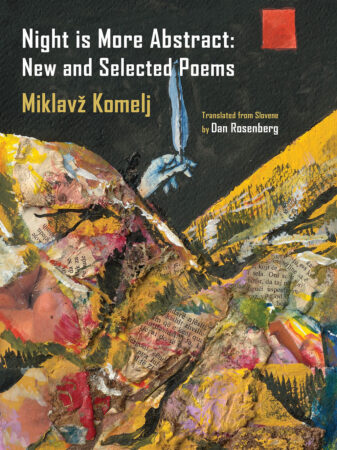
| Translated by | Dan Rosenberg |
| Genre | Poetry |
| Language(s) | Slovenian, English |
| Format | 208 Pages |
| Publisher | Zephyr Press |
| ISBN | 9781938890383 |
Reviewed by Amanda L. Andrei
Mouse bones, owl pellets, and small silver pails appear amidst the dregs of communism, karma, and resurrections as Komelj’s poems play with size and scale from the minute to the epic. This fresh translation, Night is More Abstract: New and Selected Poems, imparts the abstractness of night not only on a mundane level, but also on a cosmic one (Zephyr Press, 2025).
Born in 1973, Komelj is a Slovenian art historian, writer, and poet with seventeen books of poetry; this new translation by poet Dan Rosenberg brings in selections from seven of those volumes as well as brand new poems.
In “The Red Flag,” a lyrical whirlwind highlighting the crimson color, the poet is in conversation with filmmaker Pasolini’s Italian poem “Alla Bandiera Rossa” (“To the Red Flag”). Both poems scrutinize the red flag’s connotations with communism, class, and poverty. Komelj takes it further: “to get back to cherries, to get back to blood.” These earthy images are contrasted against Hitler, Christ, the narrator’s memories of a socialist society, and a confident sense of the mysteries of heaven and earth:
Did the gods, when they saw
the blood, find in their mouths
the taste of cherries?
(I know that feeling.)
It’s not just objects and ideologies that make their appearances. Along with dictators and religious figures, an international cadre of philosophers and artists march across the poems along with anonymous and transient folks—saints, sinners, and laypeople mingled alike. From an old man near a parking lot to the early theologian St. Augustine, from a tattooed woman on a bus to the Egyptian god Horus, Komelj conjures multiple historical and contemporary characters into his work, treating icons and strangers with equal reverence and ferocity.
Take “The Lullaby of Isis,” originally from the 2021 collection The Burning Book, in which a narrator—the Egyptian goddess Isis of magic and motherhood—considers the “down of baby hair” as it becomes a quill while she touches the head of her child Horus, the god of Sun and Sky. The tone is maternal, royal, domineering, and religious, then shifts along with its stanza structures, transforming into a series of smaller poems under the guise of the lullaby. It breaks into more fragments, the quotidian rubbing up against terror:
In the middle of the road—
a bird—
no—a black plasticbag—
no—
a slipper.How
they scream in the next
room!
The poem pulls in Latin and Italian; verses repeat as if chanted by a chorus. The words could be Isis still singing, or they could be the Sun God himself, finding his way across terra firma and repeating:
This is not a forest at night—
this is a night forest.
What you find within your might
is your greatest mystery.
Rosenberg provides a heartfelt translator’s note that emphasizes his conundrums, guiding questions, and principles as he encountered the Slovenian and multilingual poems. Pointing out conflicting translator goals and priorities, especially when teasing out assumptions of what Slovenian readers would know from Komelj’s personal poetic allusions and imagery, he muses, “Is my goal even to create an analogous experience, in English, to what Slovenian readers might encounter in his work? Is the stable notion of Slovenian readers even coherent?”
The question is as philosophical as Komelj’s verses. Who receives these tides of mundane and cosmic images, and what do they do with them?
As systems, cultures, and attitudes shift in disproportionate and unpredictable ways across the world, these questions are worthwhile for any translator as they consider their audiences and for whom they translate. Ultimately, Rosenberg’s translations reflect his desires and actions to “simply honor what is most exciting” and to create a richly textured English translation.
“I did my best not to smooth what he made rough,” he explains. In doing so, Komelj and Rosenberg present readers with a witching hour that screams, a darkness that glows.

Amanda L. Andrei is a playwright, literary translator, theater critic, and community archivist, named as one of three Rising Leaders of Color by the Theatre Communications Group (TCG) for their 2023 cohort of theater journalists. She writes epic, irreverent plays that center the concealed, wounded places of history and societies from the perspectives of diasporic Filipina women, and she co-translates from Romanian to English with her father, Codin Andrei.
She is the founder of The Palangga Archives and has presented her work on the archives at the Filipinx Studies Conference at UC Davis’ Bulosan Center for Filipino Studies. She has an MA from Georgetown University and an MFA from the University of Southern California.
SUPPORT SEEFEST
Not a member yet? Become an art patron with other SEEfest arthouse aficionados in support of great events and programs. Our mission is to keep you informed about initiatives from our wide network of fellow cultural organizations.
We Welcome YOU!
Review: First Light by Zafer Şenocak
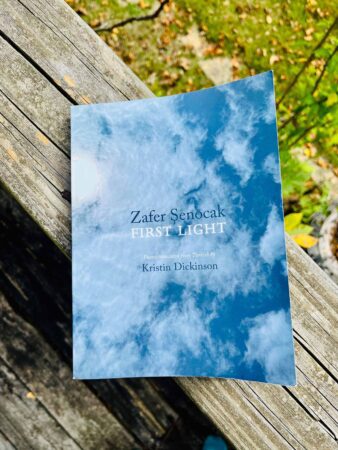
| Author | Zafer Şenocak |
| Translated By | Kristin Dickinson |
| Genre | Poetry |
| Language(s) | Turkish, English |
| Format | 160 Pages |
| Publisher | Zephyr Press |
| ISBN | 978-1-938890-30-7 |
Reviewed by Allie Rigby
What does it mean to exist in one place, physically, but mentally and emotionally exist elsewhere, simultaneously suspended in past, present, and future? Such time-warped entanglement ricochets throughout Zafer Şenocak’s bilingual poetry collection, First Light, translated from Turkish into English by Kristin Dickinson (Zephyr Press, 2024).
Many of the poems speak to the ideas of memory, language, and home, home being an ethereal concept often–if not ever so slightly–out of reach; accessible in wisps, dreams, and impressions that linger as briefly as morning light.
Şenocak’s poems ache with longing and acknowledgments of human contradictions. The original poem unfolds on the left page, in Turkish, and on the right lays the English translation.
In the poem, Muammaydun or I was a riddle (pg. 68-69), the speaker’s voice aches with loneliness and the universal desire to be known:
“I didn’t want to be an I
I wanted there to be someone
Yearning for me
My faithful companion
When you reach me
Let me be known” (Lines 16-21).
The “you” is an especially compelling address in this poem and throughout the collection. Is “you” a lover? The reader? A deeper, spiritual companion? The “cosmos” as Dickinson writes in the opening text “Unraveling the Self in Translation”? All of the above? With the “you” address, readers are brought into an intimate conversation between the speaker and someone. How readers interpret the “you” will influence each subsequent reading of the poem. But rather than get too stuck on who this “you” may be, I ask myself what the poet Brynn Saito encourages her students to ask themselves, when reading a poem for the first few times: how does the poem make me feel?
After reading I was a riddle I initially felt soothed by the longings I shared with the speaker; I also felt forlorn that loneliness was so inevitable. The repetition of “I” in Line 16 has a sense of contraction in itself–only through the “I” can the speaker express who they do and don’t want to be, and how to break free of the loneliness of the singular “I” is simultaneously impossible and desired.
The last two lines provide the solace, the hope, that someone, or something, will enter the speaker’s life and see them truly. Does this happen at death? Or before, via spiritual companionship? Or perhaps with deep friendship? Like many poets whose writing I admire, Şenocak does not answer it explicitly, but rather, lets us revel–and struggle–with the questions.
It’s impossible to ignore the role of language in any work of translation. Those who are familiar with Şenocak’s impressive canon of work, which according to his bio on Zephyr Press, includes “ten books of poetry, seven novels, and five essay collections” may know that he wrote much of his earlier work in German first, rather than in Turkish. Zephyr Press published Door Languages in 2008, which Şenocak wrote in German and Elizabeth Oehlkers Wright translated into English. First Light was written in Turkish first, as is much of Şenocak’s recent work. Translation is an art and an interpretation, the initial language of a text will influence the subsequent translations.
The relationship between language and home is deeply intertwined in this collection. In Kalbini üzme or Don’t trouble your heart (pg. 30-31), the poem flows from the title as:
“May the dust surrounding it
Never tire you
Neither home nor homesickness will come of that dust
You’ve tried enough
To make a home at the water’s edge” (Lines 1-5).
What troubles the speaker here is not the inevitability that dust falls around the heart, but rather the exhaustion that comes from this dust. There is a gentle acceptance in this address, an invitation to imagine a different kind of home: whatever actions the addressed “you” has made to make a home have not succeeded. The rich image of making a home at the water’s edge is once again soothing and promising, and yet, the speaker here reminds the “you” that they can pause that home-making attempt.
What then, does it mean, to forgo making a home? Or is home not a physical thing to make, but only possible in the form of language, itself? To be at home in language.
To–as Şenocak closes that poem–“Let the knots in your throat open.” Each poem then, an experiment into untying more of the ropes that bind us.

Allie Rigby is a poet, editor, and reviewer with roots in Orange County, California. She is the author of Moonscape for a Child (Bored Wolves, 2024) and the recipient of a Fulbright Fellowship to Romania, where she taught creative writing at Universitatea Ovidius din Constanța. She holds a master’s degree in English: Creative Writing from San Francisco State University. She enjoys connecting with people to develop and share stories that generate cross-cultural dialogue, solidarity, and change. For more of her work and upcoming events, visit www.allierigby.com or @allie.j.rigby.
SUPPORT SEEFEST
Not a member yet? Become an art patron with other SEEfest arthouse aficionados in support of great events and programs. Our mission is to keep you informed about initiatives from our wide network of fellow cultural organizations.
We Welcome YOU!
Review: Night truck driver

Night truck driver, By Marcin Świetlicki
Translated from Polish by Elżbieta Wójcik-Leese
Poetry
ISBN 9781938890802
128 pages
Bilingual: Polish and English on facing pages
Reviewed by Amanda L. Andrei
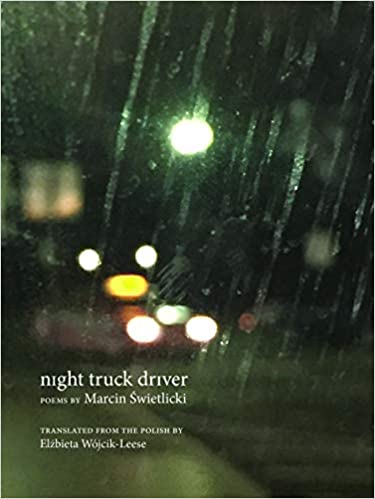
The world drips. Caught in some kind of thaw, circling a winter on the verge of melting into a dream, or a dream solidifying into a cold city, Marcin Świetlicki’s Night truck driver (Kierowca nocnej ciężarówki) translated by Elżbieta Wójcik-Leese, immerses us into icy, hypnopompic places where we can hear Death and other unseen forces calling to us—and maybe even respond to them.
The opening poem, “Preface,” invokes the biblical origins of Genesis, reset in 1960s Poland: a man, a woman, a snake, but also “a stupid apple tree,” “depots, dead buses. / Old lemonade bottles of that unusual shape.” Here are seeds of Świetlicki’s themes: an overpowering sense of menace between sleep and waking, entanglements between the masculine and feminine beyond mere mortals, set among noirish urban landscapes and frosty worlds. The final line, “We’ll be observing the advance of darkness” sets up the reader for the opaque stillness at the heart of winter, questioning what life, if any, remains beneath the cold.
“Everything drips” follows immediately with an imperative, or maybe even a plea: “Don’t come into my dreams, don’t. In one dream / drown for good and don’t show up in any other.” To whom is the speaker addressing? A relative, a lover, a stranger, a monster? The ambiguity of other people’s presences in this poem and others compounds the sense of unease, giving you the sense of a faintly remembered nightmare just out of reach, or a stranger passing by your unlit house. Later on, in “Saturday, an impulse” the speaker announces, “Evil has come to my dream,” after which a female presence instructs them to undress and return to bed where they embrace. Other poems suggest the speaker is themself a dream, conjured by a stone or a stone moon, or a person falls asleep in broad daylight, searching for a missive in the world of sleep. The space between dreamer and reverie is not simply porous or overlapping: it is all-encompassing, cavernous, dissolving into the ache of the unknown.
The female presence in the dreams, waking life, and spaces in between appears to be a lover, the mother of the speaker’s child—or perhaps many lovers, or many mothers—but also an anonymous, distant figure(s) who seems to be on a parallel yet displaced wavelength from the speaker. The speaker seems to be in constant dialogue with this presence and others like it, and even when those energies are absent from the poem’s scene, the speaker continues evoking, recalling, and defying them. Herein is the brilliance of Wójcik-Leese’s translation that melds this shadowy feminine presence with that eternal, ever-present mystery: Death.
One poem in particular showcases the paradox of having a relationship with that mystery. “Posthumous correspondence” (Korespondencja pośmiertna) takes the shape of a stage or screenplay script in which a Man dialogues with Death. Glancing on the left side of the page at the Polish, I observed that the poem followed a different structure, without the character/dialogue formatting.
Curious about this choice, I reached out to Wójcik-Leese, who explained that in Polish, death is grammatically feminine, and so verb endings signifying grammatic gender reveal which passages are spoken by Death and which passages are uttered by the other person. In their translation collaboration, Świetlicki suggested pointing out the different speakers in the exchange, which resulted in a fascinating version of the original poem in English. Both correspondents seem to be speaking aloud (as if in a script), but the framework of the text is as a letter. The reader feels the conflict and contradictions of their communication—not merely between speakers and what they speak of, but how they speak to each other and the plaintive rhythm of their exchange.
Towards the end of the collection, the poems become sparser, more like jottings and diary entries. It’s as if the narrator is integrating the past, musing over the present and future, where “Plastic soldiers utter their war cries” in the ironically titled, “First poem” which is the third to last in the volume. Maybe this is the first poem for a new world or worlds, a transition point for more. It’s significant that Świetlicki has written thirteen books of poetry and that Night truck driver is the first English language collection in his work, which Wójcik-Leese notes in the translator’s afterword “follows the chronology of his poetic life and the lives of his individual volumes.” One hopes that more translations will come, as Świetlicki and Wójcik-Leese capture so hauntingly and precisely the cold ache of being called—and caught—among many worlds.
Radio Interview with Trafika Europe where you can hear Elżbieta Wójcik-Leese read the poems in Polish and English.
Reviewer Amanda L. Andrei is a Filipina Romanian American playwright, literary translator, and teaching artist residing in Los Angeles by way of Virginia/Washington DC. She writes epic, irreverent plays that center the concealed, wounded places of history and societies from the perspectives of diasporic Filipina women, and she translates from Romanian and Filipino to English. For more information on her work and upcoming events, visit: www.AmandaLAndrei.com
SUPPORT SEEFEST
Not a member yet? Become an art patron with other SEEfest arthouse aficionados in support of great events and programs, as well as our mission to keep you informed about initiatives from our wide network of fellow cultural organizations.
We Welcome YOU!