

Review: Breadcrumbs by Kasia Babis
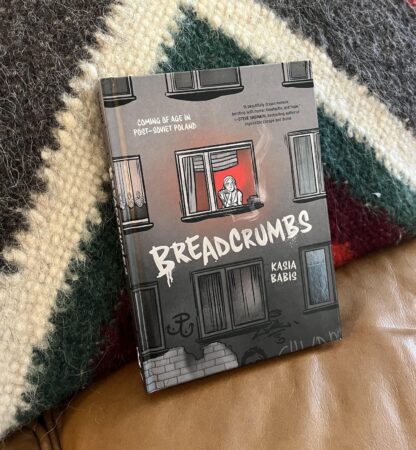
| Author | Kasia Babis |
| Genre | Graphic Memoir |
| Language(s) | English |
| Format | 256 Pages |
| Publisher | Macmillan Press |
| ISBN | 9781250877871 |
Reviewed by Lauren Halvonik
“One day you will learn respect for the fatherland, respect for bread. I will make you learn.” –Kasia Babis in Breadcrumbs
That is what the surly headmistress of Kasia’s Catholic school flings her way, in response for daring to drop breadcrumbs upon the floor. A dramatic statement following the denouement to the main character (Kaisa) reciting My Little Song III by CK Norwid. As one of the great Polish Romantic poets, Norwid is a fine choice here; his poem is about longing for the exaltation of bread and god, and of land and faith.
A New Poland
This (opening) scene sets the tone of this graphic memoir by Kasia Babis. The headmistress retreats with all the flair of a drama teacher, leaving Kasia in shock, accented by humored confusion. As Kasia and her classmates laugh over the headmistress’ eccentricities, their relationship deepens amidst the backdrop of Poland transitioning from communism to capitalism. Ultimately this is a graphic memoir about autonomy, extending from one’s body to one’s home–an extension of the self.
In this new Poland, Catholicism now sits at the forefront–not as background noise that some choose to worship, but as a cemented presence in school and state. This rising tide of conservatism, a reaction to the socialist society that had just crumbled–begins to endanger the autonomy of our young heroines. Readers may notice it foreshadowed in the make-up being scrubbed off young girls, or in the strict uniforms the girls have to wear.
Breadcrumbs conveys how in times of uncertainty and strife, people often turn to doctrine and absolutes.
Throughout the graphic memoir, mothers cling to religion like the last buoy flung off a sinking ship. Babis highlights how mothers can inflict trauma on their daughters, often out of fear. For Monika’s mother, like for many women in Poland, life is not simple. Catholic faith becomes her anchor. In one disturbing scene, Babis illustrates how daughters are reminded that abortion is a sin. Monika opens the fridge, looking for leftover dinner, and instead finds a Tupperware with a cross drawn on it and the words “Lenka 02.2010-04.2010.” In a panic, she calls Kasia to share news of the miscarried fetus in the fridge. Babis then jumps forward–the next readers learn of Monika, she’s being committed to a psychiatric institution by her mother.
Beyond the intricacies of motherhood and childhood, Monika’s story introduces the burgeoning sentiment against abortion in post-soviet Poland. Breadcrumbs is also a tale about the loss of personal autonomy and the fight to protect it. Even in Monika’s mothers actions there is a sense that she feels a loss of autonomy in this new Poland. She’s struggling financially and has no external help available to her for the care of her five children. She has to lean on Monika for help and even reminds her of that as they’re at the steps of the psychiatric institution. Her faith in Jesus and the Catholic Church makes her feel some sense of control, of autonomy.
While much of the book covers a woman’s right to bodily autonomy, it also examines personal autonomy through the lens of property.

Wild Reprivatization
“But how do you decide who owns what in a city that was once completely destroyed?” –Kasia Babis in Breadcrumbs
Babis presents the above question at the beginning of the story of Jolanta Brzeska. Brzeska was a tenants’ rights activist who many believe was murdered for her activism. Throughout the memoir, Babis uses actual quotes from witness reports, giving this section of the book a particularly eerie truth. For example, a young man reported that he saw something burning in the distance that night, precisely where Brzeska’s body was found.
In Breadcrumbs, he ask an unanswered question:
“If she just lay there, burning alive…why wasn’t she screaming?”
Strajk Kobięt
“Men’s anger. Why does it always take me by surprise?” –Kasia Babis in Breadcrumbs
In Babis’ final act, she returns to an intimate interlude that is once again, a meditation on mother’s and daughter’s, on women’s perseverance and on men’s anger. This part takes place amongst the political backdrop of Partia Razem, a left leaning party in Poland whose name signifies “togetherness” and Strajk Kobiet, the All-Poland Women’s Strike. For context, the strike unfolded in 2016 and again in 2020, largely in response to increasingly restrictive anti-abortion laws. Babis documents how,
“The battle over abortion we fought in 2016 did not put an end to the government’s war against women’s rights. In 2020, the New Constitutional Court, now packed with Law and Justice Party members, declared previous abortion laws unconstitutional. According to the new ruling, it was only legal to terminate a pregnancy if it was threatening a woman’s life or if the pregnancy was a result of rape. In response to the ruling hundreds of thousands of people went to the streets in the biggest protest since the fall of communism.”
Finally, in 2016, the protagonists feel the power of their voices. Especially Kasia, who leads a portion of the march, and speaks to the crowd with Partia Razem.
The memoir ends with the girls finding each other once again, now with Monika’s daughter, Matylda. In the light of motherhood, they reflect on their mothers and empathize with the difficulties they had. Monika contextualizes how even though her mother hurt her, her mother was also responding to her autonomy being stripped from her.
There is so much in Breadcrumbs to discuss and share. Babis takes readers on a journey through Polish history with such a beautiful and detailed pen. This memoir covers the facets of womanhood and disenfranchisement in a way that reminds readers that we all deserve autonomy. And that often, we have to fight for it.
“Sometimes I think there’s no way anyone from that generation didn’t come out at least a little bit fucked up, you know?” “Well to be fair I don’t think we’re that well-adjusted either.” “That’s how it works, right? Generational trauma or something. At least we acknowledge it. Let’s hope someday someone breaks the cycle.”
Additional Reading
- Babis, Kasia. Breadcrumbs: Coming of Age in Post-Soviet Poland. Macmillan, 2025.
- Norwood, CK. “My Little Song III” a translation of the CK Norwood poem included in Breadcrumbs.
- Tilles, Daniel. “Prosecutors Discontinue Investigation into Warsaw Tenants’ Rights Activist Who Burned to Death.” Notes From Poland.

Lauren Halvonik is a freelance writer and photographer based in Los Angeles, California. She focuses on stories from Eastern Europe, particularly those based in the Carpathian region where her family resides. She gravitates to autobiographical stories exploring identity, displacement, and the blurred borders of our cultures, language, and land.
SUPPORT SEEFEST
Not a member yet? Become an art patron with other SEEfest arthouse aficionados in support of great events and programs. Our mission is to keep you informed about initiatives from our wide network of fellow cultural organizations.
We Welcome YOU!