

Review: Antigone: In the Language of Kings
| Location | 17985 Pacific Coast Highway, Pacific Palisades, CA 90272 |
| Theater | Latino Theater Company and Getty Villa Museum Outdoor Classical Theater |
| Date of Performance | September 11, 2026 |
| Language | English, Spanish, Nahuatl |
| Photos by | Craig Schwartz |
Review By Amanda L. Andrei
The resinous scent of burning copal drifts through the arena. A grief-filled keen pierces the air. And a specter of death glides through a battlefield, sweeping corpses into black billows.
No, we’re not in ancient Greece. We’re sitting in the stone tiers of the Getty Villa, only a hundred yards away from the quartz sands of Malibu beaches. As the stars appear in the night sky, the cast of Antigone: In the Language of Kings graces the outdoor stage before us.
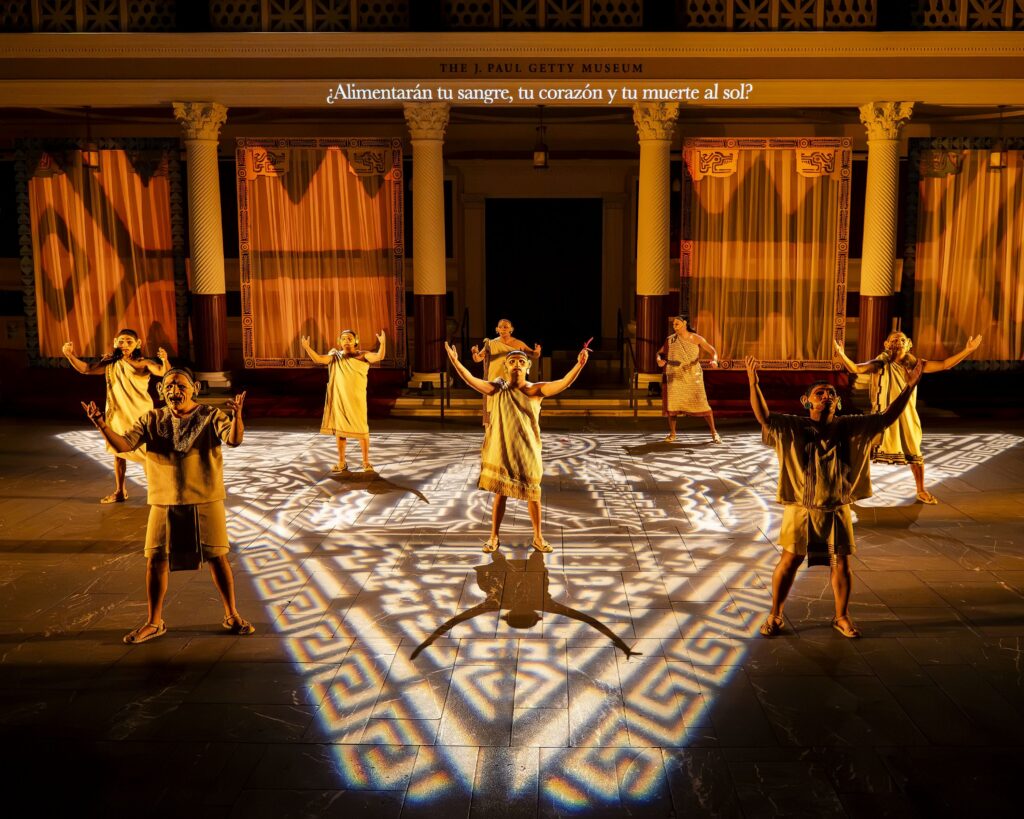
© Craig Schwartz Photography
Adapted and translated into English, Spanish, and Nahuatl by Evelina Fernández from Sophocles’ tragedy Antigone, the play places the doomed descendants of the House of Thebes within pre-conquest Tenochtitlan. With the wide open-air theater transformed into the ancient capital of the Mexihcahtl people, director Luis Jose Valenzuela fluently combines athletic dance, haunting songs, and spectacular images of death amidst the imperial court’s arguments, pleas, and threats (and surprisingly, even some Spanglish humor).
In the power vacuum remaining from the departure of the tlahtoani (ruler) Oedipo, his sons vie for the throne in a civil war that kills both princes (a movement-based narration beautifully choreographed by Urbanie Lucero). When their uncle Klion (Cástulo Guerra) assumes the throne, he forbids one of the brothers from receiving a proper burial, effectively violating the sacred laws of the ancestors and the divine. Only Antíkona takes a stand against this moral tyranny and state violence.
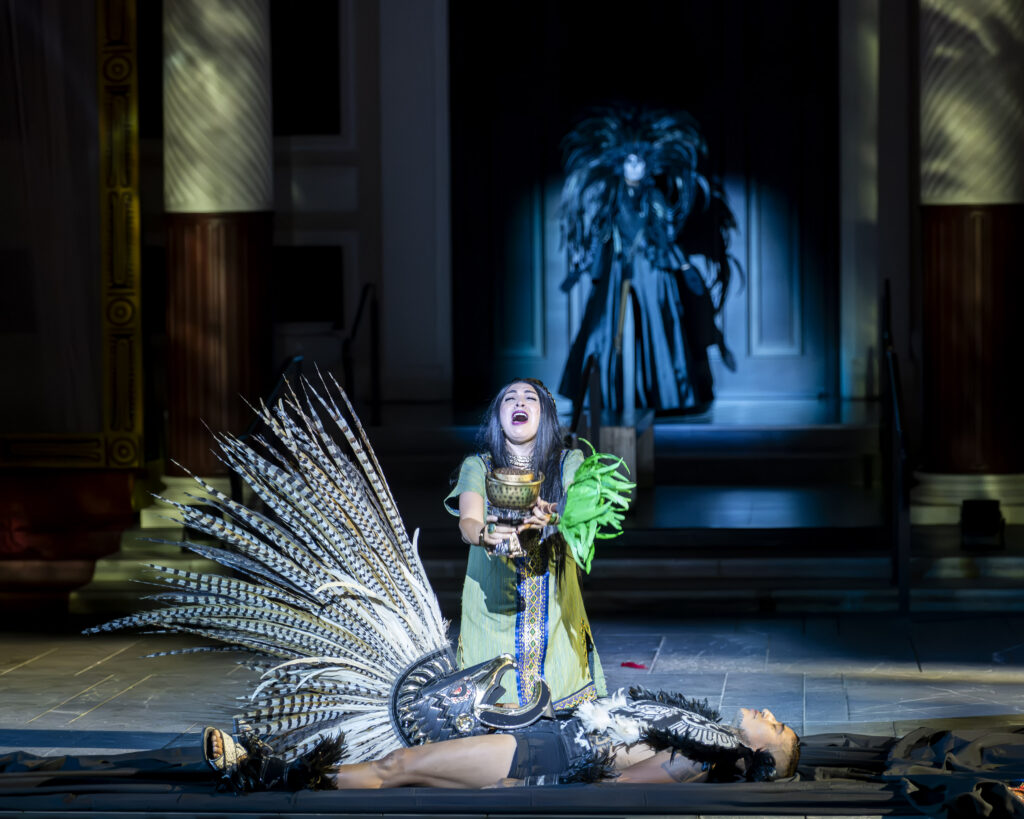
and Tiffany Bonita Litz as Miquiztli in background. © Craig Schwartz Photography
As Antíkona conducts funerary rites as a shadowy figure, decries the oppressive Aztec ruler, and addresses the masked Mexihcahtl koro (chorus), Esperanza América is utterly royal as a grief-stricken sister and morally upright citizen. It’s a pleasure to watch her verbally spar with Guerra or admonish her timid and law-abiding sister, Ixmene (Alexis B. Santiago). Antíkona’s intensity is matched by her fiancé, Hemon (an ardent José Eduardo Moreno). Their shared scene marks personal tragedy not only for the couple, but also as a political tragedy for the entire empire, victims of a ruler’s arrogant and destructive power.
The ancestral Mesoamerican music ensemble Xochi Cuicatl (Flower Songs Music) creates a ceremonial soundscape for the sumptuous visuals (scenic design by François-Pierre Couture and lighting design by “Lee” Xinyuan Li). Catarina Copelli’s costumes burst with feathered plumes, bold lines of traditional makeup, and expressive masks. The effect is reminiscent not only of Western theater’s Mediterranean roots, but also calls upon the unique design elements of pre-conquest America. Similarly, Fernández’s translation choices between English, Spanish, and Nahuatl impart a sense of rich linguistic texture and social registers, especially when the koro sings in Nahuatl to remember and honor deceased family members.
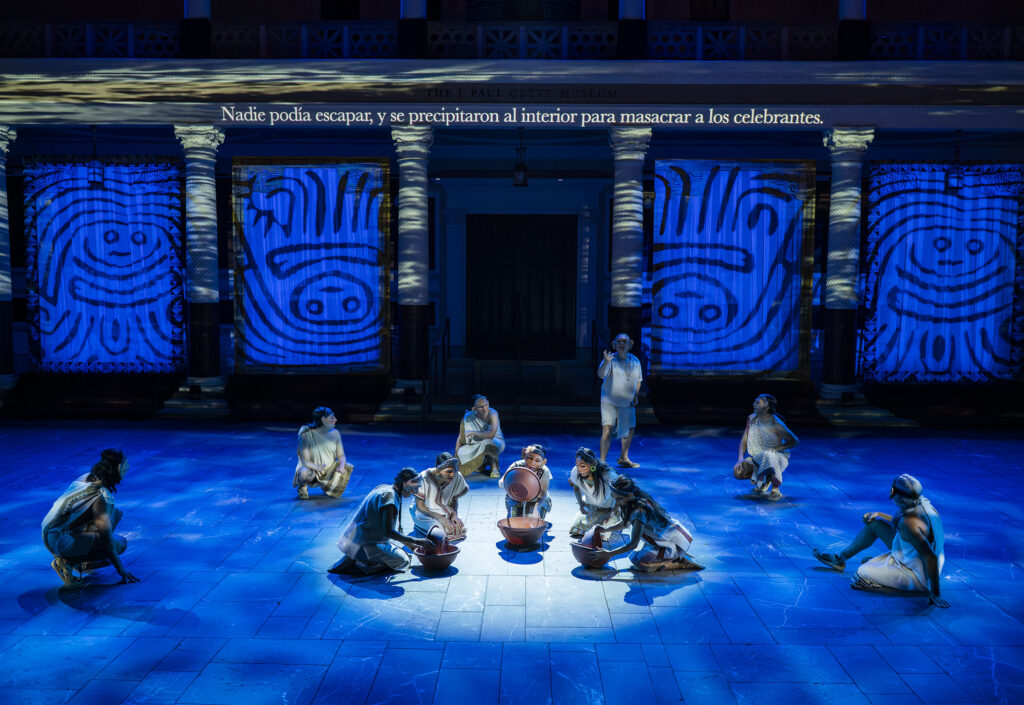
© 2026 J. Paul Getty Trust
Ultimately, this operatic performance serves as a warning to tyrants and the morally weak and silent. In voices that fill the semi-circles of the theater, their message reverberates against the villa’s darkened hills and the Pacific’s foaming tides:
A good ruler should be like a great tree that gives shade, that gives cover, that gives shelter.
Nelli in itlahtoh. (Her words are true.)
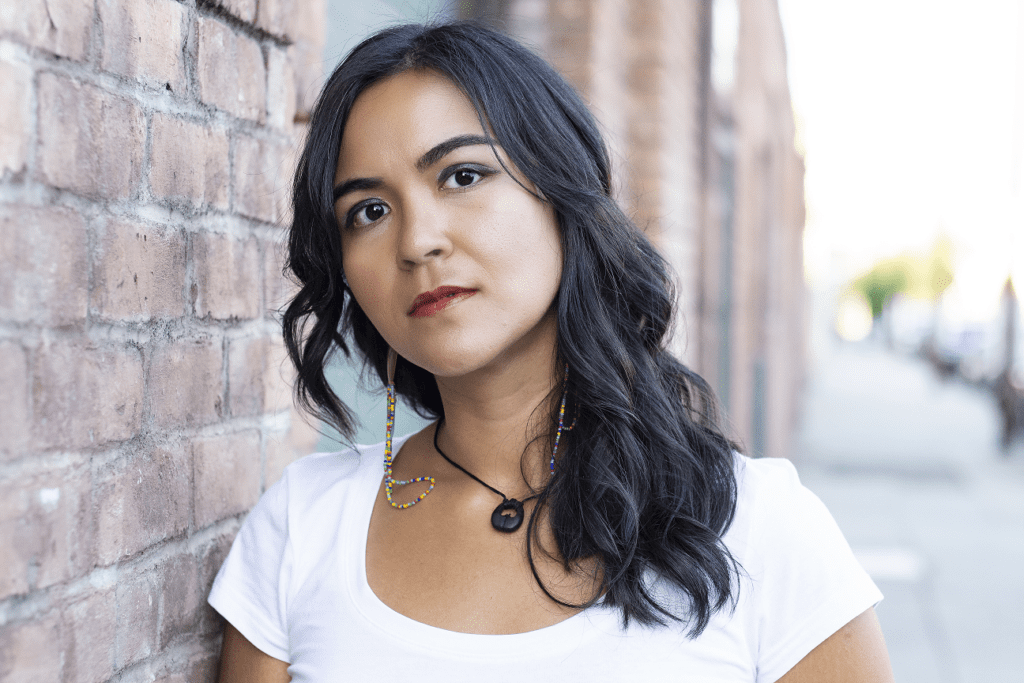
Amanda L. Andrei is a playwright, literary translator, theater critic, and community archivist, named as one of three Rising Leaders of Color by the Theatre Communications Group (TCG) for their 2023 cohort of theater journalists. She writes epic, irreverent plays that center the concealed, wounded places of history and societies from the perspectives of diasporic Filipina women, and she co-translates from Romanian to English with her father, Codin Andrei.
She is the founder of The Palangga Archives and has presented her work on the archives at the Filipinx Studies Conference at UC Davis’ Bulosan Center for Filipino Studies. She has an MA from Georgetown University and an MFA from the University of Southern California.
SUPPORT SEEFEST
Not a member yet? Become an art patron with other SEEfest arthouse aficionados in support of great events and programs. Our mission is to keep you informed about initiatives from our wide network of fellow cultural organizations.
We Welcome YOU!